Tpa Clot Treatment
Posted : admin On 3/31/2022When a large artery is blocked or occluded, also known as an ischemic stroke, the UPMC Stroke Institute uses advanced therapies to restore blood flow and help improve outcomes.
Depending on the patients condition, the size of the clot, and the hours passed since the onset of symptoms, these therapies can include the following treatments.
However, there are no clear guidelines for treatment. In our case, the decision to give tPA was made based on the acute RV strain and potential for circulatory collapse if the RA clot propagated. The use of thrombolytics in treatment of CIT has been shown to be effective and safer than surgical embolectomy or anticoagulation therapy alone. May 15, 2008 (Nice, France) — Treatment of intraventricular hemorrhage (IVH) with catheter-based clot lysis using low-dose tissue plasminogen activator (tPA) is safe and dramatically reduces death.
Clot-Dissolving Drugs
Clot-dissolving drugs are given within four-and-a-half hours of the onset of symptoms. Tissue plasminogen activator (tPA) is given through a vein in the arm after the doctor has confirmed the stroke's cause, and there is no evidence of bleeding.

Mechanical Clot Removal Devices to Loosen and Remove Clots
During a mechanical clot removal procedure, a catheter is threaded into an artery at the groin and up through the neck, until it reaches the blood clot causing the stroke.
This procedure can also be used on select patients who present with stroke outside of the window for IV tPA or who are not able to receive the treatment due to a medical condition or medications they take.
Using x-ray guided imaging, a stent retriever is inserted into the catheter. The stent reaches past the clot, expands to stretch the walls of the artery so blood can flow, and is finally “retrieved” — pulled backwards — which removes the clot. Learn more about mechanical clot removal.
Intra-Arterial Thrombolytic Treatment
Uses a long tube threaded through a blood vessel and into the brain to deliver clot-dissolving drugs, such as tPA, to the site of a blood clot causing a stroke. Because this method delivers a relatively high dose directly to the clot, it may be more effective and cause fewer side effects than delivering these medications to the whole body.
This procedure can also be used on select patients who present with stroke outside of the window for IV tPA& or who are not able to receive the treatment due to a medical condition or medications they take.

Surgical Treatments
In addition to advanced therapies, surgery may be performed following an ischemic stroke or transient ischemic attack (TIA) to prevent a recurrence.
Surgical techniques include:
- Carotid endarterectomy removes fatty deposits from a carotid artery, a major artery in the neck that leads to the brain.
- Extracranial/intracranial bypass reroutes the blood supply around a blocked artery using a healthy scalp artery.
Additional Stroke Treatments

Investigational therapy
An investigational therapy, neural implantation for stroke, first performed at UPMC, uses minimally invasive surgery to place engineered nerve cells in stroke-damaged areas of the brain.
UPMC studies of neural implantation have provided the first preliminary evidence that implanted cells can grow and take the place of nerve cells killed by a stroke.
Stroke rehabilitation
Some stroke patients can benefit from stroke rehabilitation. The UPMC Stroke Institute offers a comprehensive stroke rehab program to help patients recover deficits the best they can.
Make an Appointment
To schedule an appointment, please call 412-232-8840 or complete a contact form.
Stroke Resources
Tpa Clot Buster Side Effects
When you are having a stroke, you need to go to the ER ASAP, undergo a CT STAT and receive tPA through an IV if necessary. In other words, upon recognizing the symptoms of a stroke, you should proceed to the nearest emergency room (ER) as soon as possible (ASAP). Upon arrival, you would undergo a computed tomography (CT) scan immediately (STAT) to determine the cause of the stroke. If a blood clot is detected during the scan, you may receive tissue plasminogen activator (tPA) intravenously (IV) to help break up the blood clot.
More than 80 percent of strokes are caused by a blood clot that moves into a vessel and blocks blood flow. These ischemic strokes typically are treated with tPA, a clot-busting drug that helps dissolve the blood clot and restore blood flow to the brain. Strokes also may be caused by the rupture of a weakened blood vessel, resulting in blood leaking into the brain. These hemorrhagic strokes should not be treated with tPA because the medication could cause increased bleeding.
The key to successful treatment for ischemic strokes is rapid treatment. That is because when tPA is administered within three hours of the onset of symptoms, it can help reduce disability and limit damage caused by lack of blood flow to the brain. Although tPA usually is given through an IV, it also can be delivered through a long catheter that is guided through blood vessels directly to the blockage. This alternative may benefit patients when treatment cannot begin within three hours after stroke symptoms started or when initial tPA treatment has not been sufficient to dissolve the blood clot. The local administration of tPA can occur up to six hours after the onset of stroke symptoms.
The decision to use tPA or other clot-busting drugs, also called thrombolytics, is based on numerous factors, including age, gender and medical history.
In general, tPA is not recommended for patients who are pregnant or have:
- A history of bleeding problems.
- Uncontrolled high blood pressure or endocarditis
- (infection of the lining of the heart).
- Had recent surgery or injury.
- Diabetic retinopathy (eye problems due to diabetes).
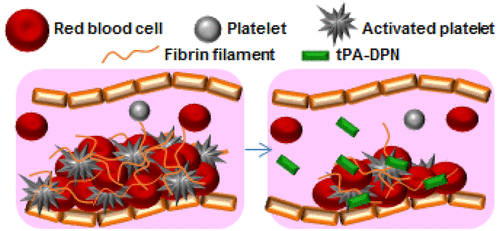
In addition to treating ischemic strokes, thrombolytic therapy using tPA also may be used to treat clots in the lungs, deep veins in the legs, heart, or arteries elsewhere in the body. However, clots may reform in blood vessels, especially if the underlying cause for the blockages is not properly diagnosed and treated. Following treatment with tPA, patients are advised not to take anticoagulants or antiplatelets, such as aspirin, which could interfere with normal clotting.
Tpa Clot Treatment Symptoms
If you experience the warning signs of a stroke, such as sudden numbness or weakness on one side of the body, confusion, difficulty speaking, blurred vision, sudden headache or trouble walking, call 9-1-1 right away. A stroke is an emergency that requires immediate medical attention.